Overview
In factories, warehouses, offices, and public facilities, lighting systems play an important role in safety and operational efficiency. However, manually inspecting each light is time-consuming, prone to oversight, and often detects faults only after operations have been affected.
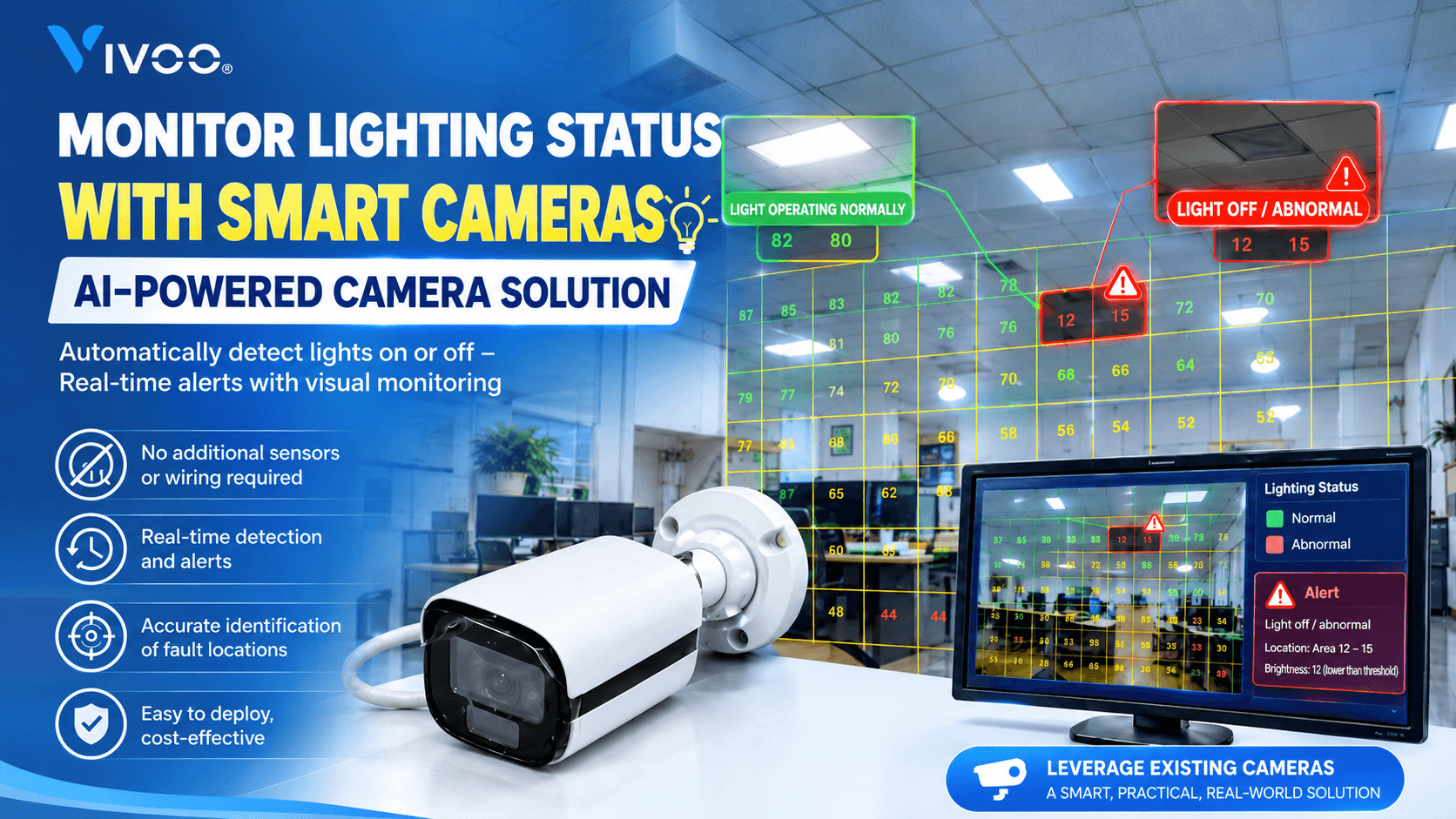
Our solution turns existing surveillance cameras into “intelligent light sensors”, automatically monitoring lighting across an entire area and issuing alerts as soon as a light switches off or its brightness decreases – without installing additional sensors or wiring each light individually.
Common Challenges
Manual inspections: personnel must patrol and visually inspect each area, consuming time and resources.
Delayed detection: faulty lights are often discovered only after a report is received or an incident occurs.
High sensor costs: installing a measurement device on every light requires substantial equipment and installation investment.
Large areas and high ceilings: regular observation and inspection are difficult.
How does the solution work?
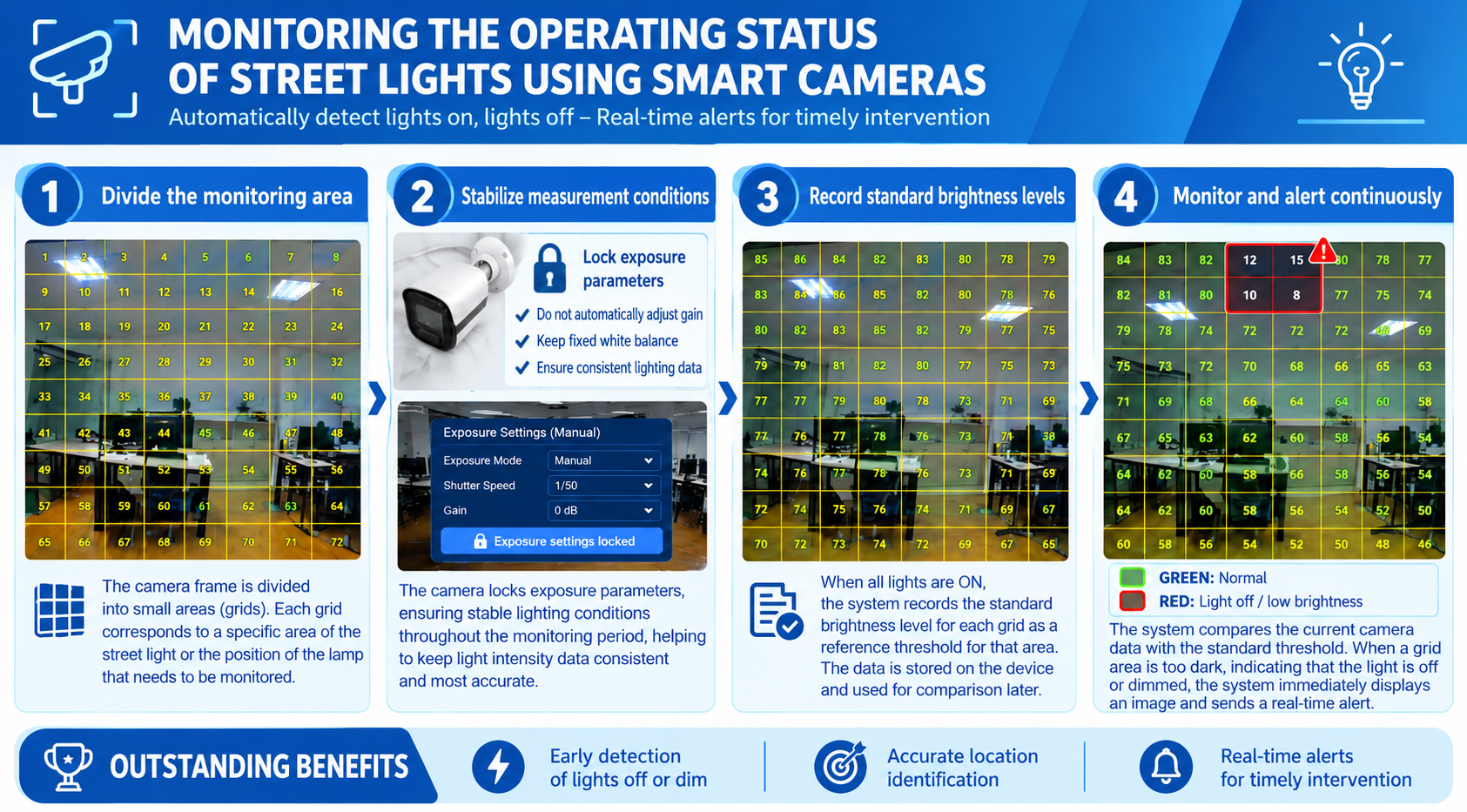
1) Divide monitoring zones
The camera image is divided into a grid of small cells. Each cell corresponds to a lighting zone or a particular light fixture to be monitored.
2) Stabilize measurement conditions
The camera exposure settings are locked to prevent the image from automatically becoming brighter or darker, ensuring accurate and consistent brightness measurements.
3) Record standard brightness level
When all lights are ON, a single action saves a “baseline brightness map” of the area. This data is stored on the device and retained even after a restart.
4) Continuous monitoring & alerting
The camera continuously compares current brightness against the baseline. When a zone becomes noticeably darker, the system immediately highlights the alert on the image.
Visual Alerts
On the monitoring screen, each grid cell displays a brightness value, with its color indicating the status:
GREEN | Light operating normally – brightness remains stable relative to the baseline. |
RED + ALERT FRAME | Light switched off or dimmed – brightness in the area has fallen beyond the allowed threshold. |
Operators only need to look at the screen to immediately identify the location of the problematic light, without needing to read complex data or reports.
Outstanding Benefits
Leverage existing infrastructure: use existing surveillance cameras without installing a sensor for each light.
Immediate detection: receive real-time alerts when a light switches off or its brightness decreases.
Accurate fault localization: identify the affected area precisely to enable a quick response.
Simple deployment: one-step calibration with no complex configuration required.
Adjustable sensitivity: easily configure the alert threshold to suit different environments.
Lightweight and reliable: processing runs directly on the camera, without requiring a server or a resource-intensive AI model.
Cost savings: reduce routine inspection labor and maintenance costs.
Practical Applications
Sector | Purpose of use |
Workshops, factories | Monitor high-bay lighting systems to help ensure occupational safety. |
Warehouses, logistics centers | Monitor lighting across large areas with multiple rows of shelving. |
Offices, buildings | Manage lighting in corridors, lobbies, and meeting rooms. |
Parking lots, basements | Detect faulty lights in low-traffic areas. |
Public works | Railway stations, airports, hospitals, and schools. |